From Bench to Bedside: Clinical practice examples
Example 5: Hematological Outpatient Unit, Innsbruck University Hospital and Medical University, Austria – outpatient
Background
As of 2024, the University Hospital Innsbruck has several implementations and projects, in which PROMs are used as part of clinical care in different patient populations (eg, oncology, psychiatry, paediatrics). This example describes an implementation at the Haematological Outpatient Unit.
The PRO assessment at the haematological outpatient unit were originally conducted as part of a clinical registry. The Austrian Myeloma Registry merged PRO data collected at the hospital with clinical data. In 2017, the first PRO assessments were conducted electronically and integrated into routine clinical care. Initially, assessments were conducted only at the hospital using a tablet computer. In the following years, we have extended the PRO monitoring program and added different new components to the implementation which are described below (a patient portal for remote PROM completion, self-management advice, a dedicated symptom monitoring program).


Main objectives: We use PRO assessments to systematically evaluate patient-reported symptoms, side effects, and overall well-being to
- Improve quality of life (QoL) in patients with haematological cancers by enabling a more patient-centred approach and timely, targeted interventions for symptom and treatment-related problems.
- Collect PRO data for a clinical registry and research, to better understand patient experiences and outcomes over time
Target groups: This approach is tailored to haematological malignancies, including multiple myeloma and chronic lymphocytic leukaemia (CLL).

Instruments: We use different PROMs depending on diagnosis, treatment, and appointment schedule. All patients complete the EORTC QLQ-C30 (completion time: ~2.9 min). Depending on diagnosis, we add: QLQ-MY20 (multiple myeloma, completion time: ~4.7 min), QLQ-CLL17 (chronic lymphocytic leukaemia, completion time: ~4.4 min)1
Assessment times: Time intervals are flexible to best adapt to the routine care schedule; some patients are seen every 6 months (e.g., watch-and-wait), others weekly or bi-weekly during active outpatient treatment. At longer intervals (baseline and every three months), we also use the Hornheider Screening Inventory (HSI) to screen for psycho-oncological distress.
Workflow: Patients are asked to complete PROs a few days before their next visit via the patient portal (https://ches.tirol-kliniken.at/haemonko/portal). If they cannot access the portal or forget, they can complete the assessment in the outpatient unit before the consultation to ensure up-to-date information is available.
Symptom monitoring program: For multiple myeloma patients on active treatment, we run a weekly symptom-monitoring program (SymOn)2 using short, treatment-specific item lists (e.g., including ocular symptoms for certain regimens). Questions are drawn from the EORTC Item Library and were developed with interest-holder input (see the Appendix of the publication3).
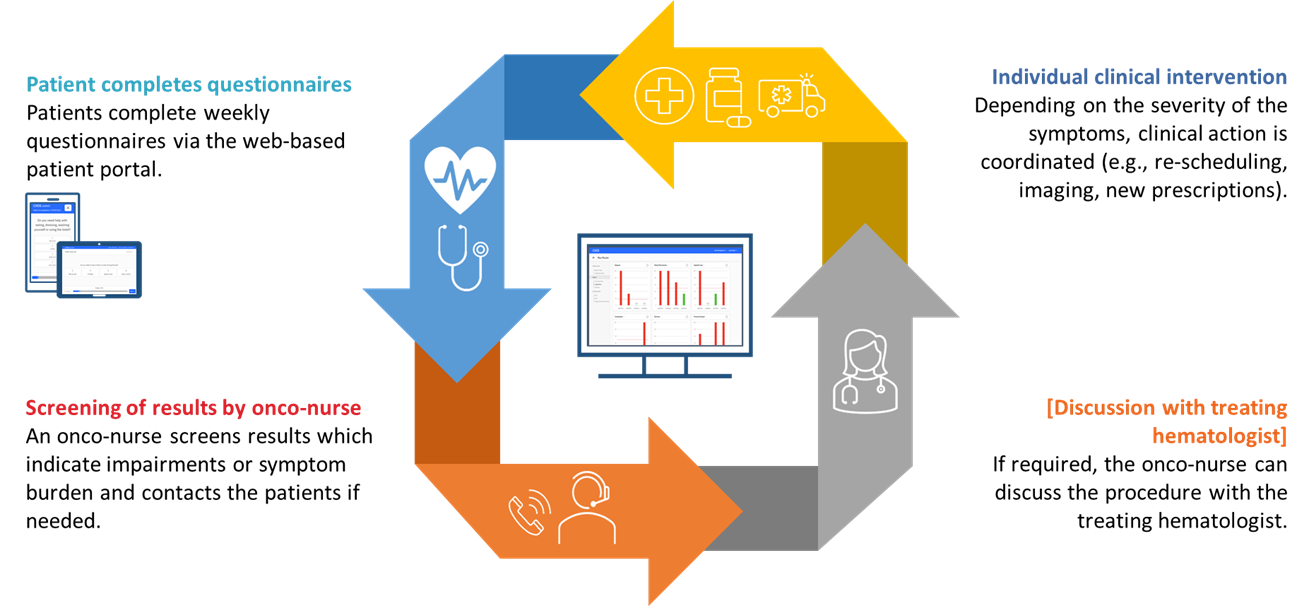

Electronic assessment: We use electronic-only PROM capture because results are used clinically and must be available to the care team immediately after completion. Electronic assessment also supports patient engagement, e.g., via our patient portal with graphical result displays.
PRO assessment software: Our system is CHES (Computer-based Health Evaluation System), developed in Innsbruck and used for years in Austria and internationally.4 It has been continuously refined for our unit, including a portal for remote PROM completion5 and a-monitoring programme with active team review of PROM results.6

Integrating PROMs into routine care was challenging and required close collaboration between PRO researchers and clinical staff.
Initial implementation: Initial implementation followed the participatory Replicating Effective Programs (REP) framework (Kilbourne et al., 2007) involving all relevant interest-holders, see Sztankay et al.7 for details.
Gradual improvement: After rollout, the system was iteratively improved with interest-holder input to find the best possible system configuration and ensure their ongoing commitment. Improvements included adding a patient portal (2017)8 and launching a symptom-monitoring programme (2019)9, aimed to address patient needs (support/communication from home) and team needs (better data visualisation and documentation of actions taken)
Key factors of success: A key factor was a dedicated ePRO facilitator who briefed patients, supported portal/technical issues, enabled in-clinic completion when remote completion was not possible, and communicated results to the team. As not all clinicians used the platform frequently despite having access, the facilitator reviewed scores on patient appointment days and flagged concerning values to the treating physician.
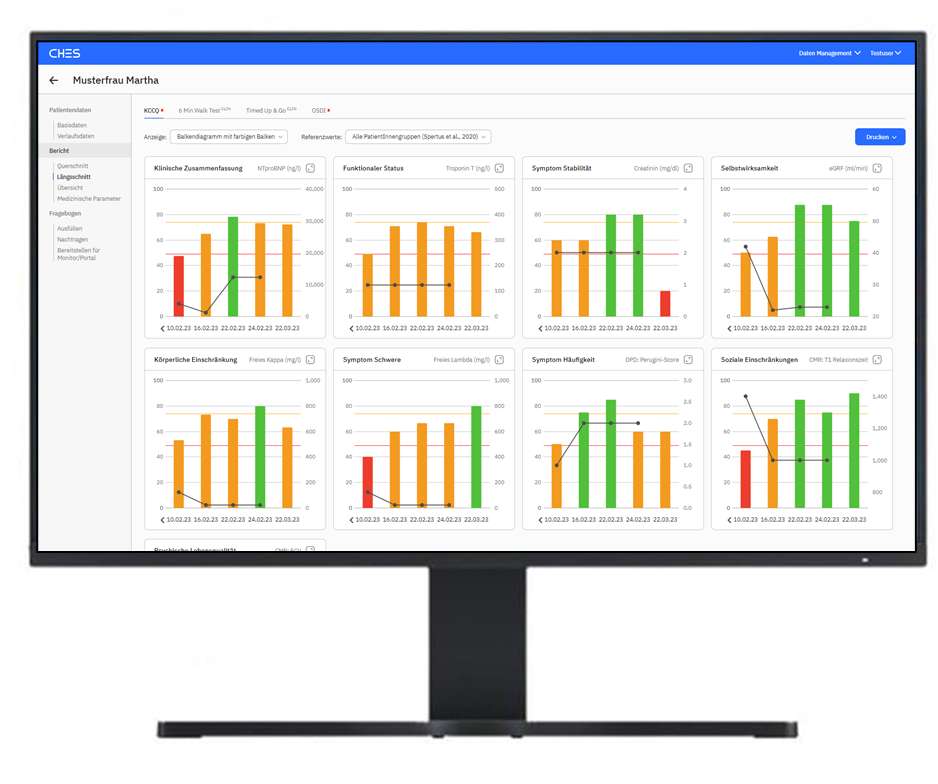

PRO data scoring and color coding: PROM data are visualised in the CHES clinician interface: scores are auto-calculated, shown with selected reference values, and highlighted via colour coding. Clinicians can view results cross-sectionally or longitudinally; the longitudinal view supports interpretation of change over time and displays treatment type alongside scores to relate HRQoL changes to therapy phases.
Interpretation approaches: Thresholds of clinical importance (Giesinger et al.)10 are used for the EORTC QLQ-C30 and local patient reference data for the QLQ-MY20 and QLQ-CLL17 (no thresholds yet). SymOn symptom lists11 use custom thresholds developed with input from physicians, nurses, and ePRO experts. The HSI uses a validated cut-off to flag patients who may benefit from psycho-oncological care.12
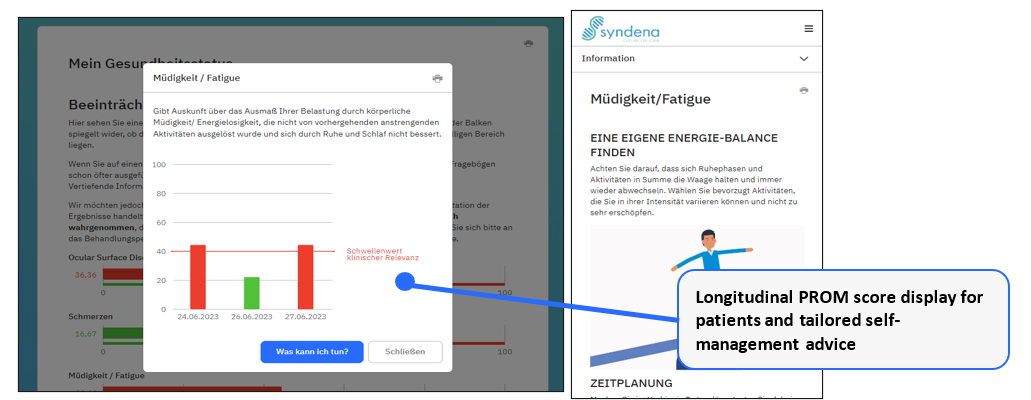
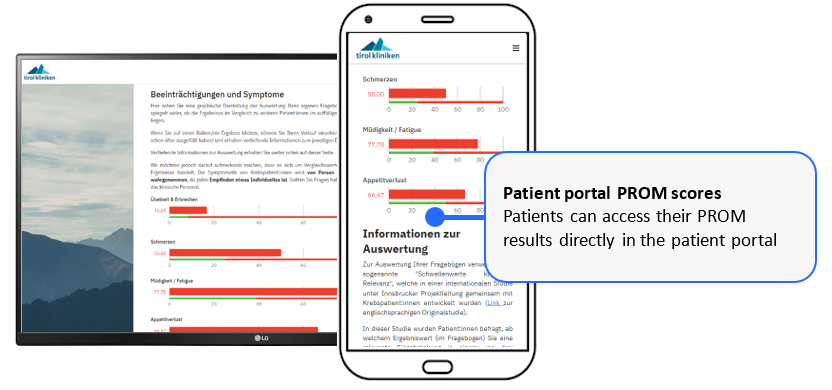
Patients can also view their own, similarly colour-coded PRO data in the patient portal:
Figure 2. Example screenshot of the patient portal display of PRO data and possibility to view self-management information prompted by the results.

Ensuring consideration of relevant data: PRO data are accessible to the whole care team, but in routine practice not everyone reviews them. Physician engagement varies and some clinicians remain unconvinced of PROM benefits. To prevent missed deteriorations, the ePRO facilitator reviews all PRO data daily and flags relevant changes to the treating physician.
Symptom monitoring program: For patients in the dedicated program, an oncology nurse regularly reviews remotely completed PROMs, contacts patients if concerning changes occur (e.g., a new symptom), discusses the results, and coordinates appropriate clinical actions when needed.
Although communication resources for physicians are available, they are rarely used.

PRO data support both research (Austrian Myeloma Registry) and routine care. Here, we focus on the use in clinical practice.
Analysing PRO-based clinical action: In a study13 tracking PRO-based clinical actions, ~46% of remote symptom assessments contained at least one “critical” score generating an alert, most frequently for dyspnoea, pain, and fatigue. Alerts usually led to symptom discussion and/or self-management advice via the portal; less often to supportive-care referral (e.g., psycho-oncology, social work). Only rarely (<2% of alerts) did they prompt medication changes, additional diagnostics, or unplanned emergency admission, but these actions were perceived as particularly valuable by the clinical team.
Cut-offs are continuously refined to ensure relevant symptoms are not missed while minimising false alerts.
Feedback on selected PRO data: Patients receive feedback on their PRO data via the patient portal. PROM scores are shown on a 0–100 scale and colour-coded using the Thresholds for Clinical Importance14. At present, we display only the EORTC QLQ-C30 scale as we found that displaying too many PRO data was perceived as overwhelming.
Self-management advice: Scores for each scale are linked to dynamically displayed self-management advice. By clicking a result, patients can view their scores over time (longitudinal view) and directly access tailored self-management guidance for that specific domain. Patients particularly value being able to see and interpret their own scores and appreciate the linked self-management pages.

Start somewhere: PROM implementation can feel overwhelming, so begin with clear, manageable goals. Integrate PROMs into step by step and expect it to take time. For us, it took several years to reach our current solution—and we are still continuously planning next steps.
Involve interest-holders and clinical champions: Two major drivers were involving interest-holders (e.g., patients and HCPs) in software development and PROM integration, and clinical champions who actively promoted PROM use among colleagues.
Schedule time to review and work with PROMs: Introducing patients to PROMs and the patient portal can require additional staff capacity. Where possible, allocate personnel to onboard patients to the PRO platform and to be available for questions from the clinical team.
1Lehmann J, Buhl P, Giesinger JM, Wintner LM, Sztankay M, Neppl L, Willenbacher W, Weger R, Weyrer W, Rumpold G, Holzner B Using the Computer-based Health Evaluation System (CHES) to Support Self-management of Symptoms and Functional Health: Evaluation of Hematological Patient Use of a Web-Based Patient Portal J Med Internet Res 2021;23(6):e26022
2Lehmann J, de Ligt KM, Tipelius S, Giesinger JM, Sztankay M, Voigt S, van de Poll-Franse LV, Rumpold G, Weger R, Willenbacher E, Willenbacher W, Holzner B Adherence to Patient-Reported Symptom Monitoring and Subsequent Clinical Interventions for Patients With Multiple Myeloma in Outpatient Care: Longitudinal Observational Study J Med Internet Res 2023;25:e46017
3Lehmann J, de Ligt KM, Tipelius S, Giesinger JM, Sztankay M, Voigt S, van de Poll-Franse LV, Rumpold G, Weger R, Willenbacher E, Willenbacher W, Holzner B Adherence to Patient-Reported Symptom Monitoring and Subsequent Clinical Interventions for Patients With Multiple Myeloma in Outpatient Care: Longitudinal Observational Study J Med Internet Res 2023;25:e46017
4Holzner, B., Giesinger, J. M., Pinggera, J., Zugal, S., Schöpf, F., Oberguggenberger, A. S., Gamper, E. M., Zabernigg, A., Weber, B., & Rumpold, G. (2012). The Computer-based Health Evaluation Software (CHES): a software for electronic patient-reported outcome monitoring. BMC medical informatics and decision making, 12, 126. https://doi.org/10.1186/1472-6947-12-126
5Lehmann, J., Buhl, P., Giesinger, J. M., Wintner, L. M., Sztankay, M., Neppl, L., Willenbacher, W., Weger, R., Weyrer, W., Rumpold, G., & Holzner, B. (2021). Using the Computer-based Health Evaluation System (CHES) to Support Self-management of Symptoms and Functional Health: Evaluation of Hematological Patient Use of a Web-Based Patient Portal. Journal of medical Internet research, 23(6), e26022. https://doi.org/10.2196/26022
6Lehmann, J., de Ligt, K. M., Tipelius, S., Giesinger, J. M., Sztankay, M., Voigt, S., van de Poll-Franse, L. V., Rumpold, G., Weger, R., Willenbacher, E., Willenbacher, W., & Holzner, B. (2023). Adherence to Patient-Reported Symptom Monitoring and Subsequent Clinical Interventions for Patients With Multiple Myeloma in Outpatient Care: Longitudinal Observational Study. Journal of medical Internet research, 25, e46017. https://doi.org/10.2196/46017
7Sztankay, M., Neppl, L., Wintner, L. M., Loth, F. L., Willenbacher, W., Weger, R., Weyrer, W., Steurer, M., Rumpold, G., & Holzner, B. (2019). Complementing clinical cancer registry data with patient reported outcomes: A feasibility study on routine electronic patient-reported outcome assessment for the Austrian Myelome Registry. European journal of cancer care, 28(6), e13154. https://doi.org/10.1111/ecc.13154
8Lehmann, J., Buhl, P., Giesinger, J. M., Wintner, L. M., Sztankay, M., Neppl, L., Willenbacher, W., Weger, R., Weyrer, W., Rumpold, G., & Holzner, B. (2021). Using the Computer-based Health Evaluation System (CHES) to Support Self-management of Symptoms and Functional Health: Evaluation of Hematological Patient Use of a Web-Based Patient Portal. Journal of medical Internet research, 23(6), e26022. https://doi.org/10.2196/26022
9Lehmann, J., de Ligt, K. M., Tipelius, S., Giesinger, J. M., Sztankay, M., Voigt, S., van de Poll-Franse, L. V., Rumpold, G., Weger, R., Willenbacher, E., Willenbacher, W., & Holzner, B. (2023). Adherence to Patient-Reported Symptom Monitoring and Subsequent Clinical Interventions for Patients With Multiple Myeloma in Outpatient Care: Longitudinal Observational Study. Journal of medical Internet research, 25, e46017. https://doi.org/10.2196/46017
10Giesinger, J. M., Loth, F. L. C., Aaronson, N. K., Arraras, J. I., Caocci, G., Efficace, F., Groenvold, M., van Leeuwen, M., Petersen, M. A., Ramage, J., Tomaszewski, K. A., Young, T., Holzner, B., & EORTC Quality of Life Group (2020). Thresholds for clinical importance were established to improve interpretation of the EORTC QLQ-C30 in clinical practice and research. Journal of clinical epidemiology, 118, 1–8. https://doi.org/10.1016/j.jclinepi.2019.10.003
11Lehmann, J., de Ligt, K. M., Tipelius, S., Giesinger, J. M., Sztankay, M., Voigt, S., van de Poll-Franse, L. V., Rumpold, G., Weger, R., Willenbacher, E., Willenbacher, W., & Holzner, B. (2023). Adherence to Patient-Reported Symptom Monitoring and Subsequent Clinical Interventions for Patients With Multiple Myeloma in Outpatient Care: Longitudinal Observational Study. Journal of medical Internet research, 25, e46017. https://doi.org/10.2196/46017
12Screeningverfahren in der Psychoonkologie Testinstrumente zur Identifikation betreuungsbedürftiger Krebspatienten Eine Empfehlung der PSO für die psychoonkologische Behandlungspraxis P. Herschbach, J. Weis (Hrsg.) Berlin 2010, 2. Auflage
13Lehmann J, de Ligt KM, Tipelius S, Giesinger JM, Sztankay M, Voigt S, van de Poll-Franse LV, Rumpold G, Weger R, Willenbacher E, Willenbacher W, Holzner B Adherence to Patient-Reported Symptom Monitoring and Subsequent Clinical Interventions for Patients With Multiple Myeloma in Outpatient Care: Longitudinal Observational Study J Med Internet Res 2023;25:e46017
14Giesinger, J. M., Loth, F. L. C., Aaronson, N. K., Arraras, J. I., Caocci, G., Efficace, F., Groenvold, M., van Leeuwen, M., Petersen, M. A., Ramage, J., Tomaszewski, K. A., Young, T., Holzner, B., & EORTC Quality of Life Group (2020). Thresholds for clinical importance were established to improve interpretation of the EORTC QLQ-C30 in clinical practice and research. Journal of clinical epidemiology, 118, 1–8. https://doi.org/10.1016/j.jclinepi.2019.10.003